Something has shifted. Maybe the same argument keeps circling back with no resolution. Maybe you feel like housemates rather than partners. Or maybe nothing dramatic has happened at all — just a quiet sense that the two of you have grown further apart than either of you intended.
If any of that sounds familiar, you are not alone — and you are certainly not alone in Brighton and Hove. The pressures this city places on relationships are real, specific, and rarely spoken about openly. This guide is for couples who want to understand those pressures, get properly informed about the options available, and know what to expect if they decide to take the step of seeking support.
It covers the particular strains of life in Brighton and Hove, the main therapy approaches used by qualified practitioners, how online couples therapy works and why it suits many couples here, the kinds of challenges therapy can address, practical steps for each, and what to look for when choosing a therapist.
The practical steps included throughout are not a substitute for professional support. They are a starting point — small, grounded actions that can begin to shift something before, during, or alongside therapy.
The Pressure Brighton and Hove Places on Relationships
Brighton and Hove is one of the most culturally alive, progressive, and beautiful cities in the UK. It is also one of the most financially demanding places to build a shared life.
The average house price in the city sits at around £410,000, with the typical deposit required pushing towards £75,000.¹ Most couples are saving towards that figure while already spending approximately 46% of their income on rent — compared to the UK average of 35.7%.² That gap matters. When nearly half of what you earn disappears before food, utilities, or any kind of discretionary spending, the pressure doesn’t stay separate from the relationship. It bleeds through.
For couples renting along the Lewes Road corridor or in the seafront wards where older housing stock carries high utility costs, financial strain becomes a background hum that rarely fully switches off.
Add to that the commute. Around 25% of Brighton’s working population travel to London regularly.³ Door-to-door, that often amounts to four hours a day. A couple where both partners commute can easily spend twelve hours apart — and return home too depleted to do anything more than decompress separately. The bonding activities that once came naturally — dinner along the seafront, a walk up to the Devil’s Dyke, a weekend away — get quietly dropped. Not because you don’t want them, but because time and money have both contracted.
The digital and creative industries that cluster around the city centre have grown significantly — jobs in tech and creative fields increased by around 38–40% over the last five years.³ But real wages, after accounting for inflation, have fallen. The average Brighton and Hove resident is approximately £2,000 worse off per year in real terms than in 2011.¹ Growth and financial pressure exist simultaneously, which creates its own particular strain.
Brighton and Hove’s own Health Counts 2024 survey — the largest health and wellbeing study ever conducted in the city, involving over 16,700 adults — found that 24% of residents recorded low happiness scores, higher than the national average.⁴ Anxiety levels here sit consistently above average too. That psychological burden doesn’t remain contained to individuals. It shapes how couples speak to each other, how they argue, and how present they are able to be.
These are not background statistics. They are the conditions inside which real couples are trying to stay connected, stay kind, and stay in love.
What Is Couples Therapy — and What Is It Not?
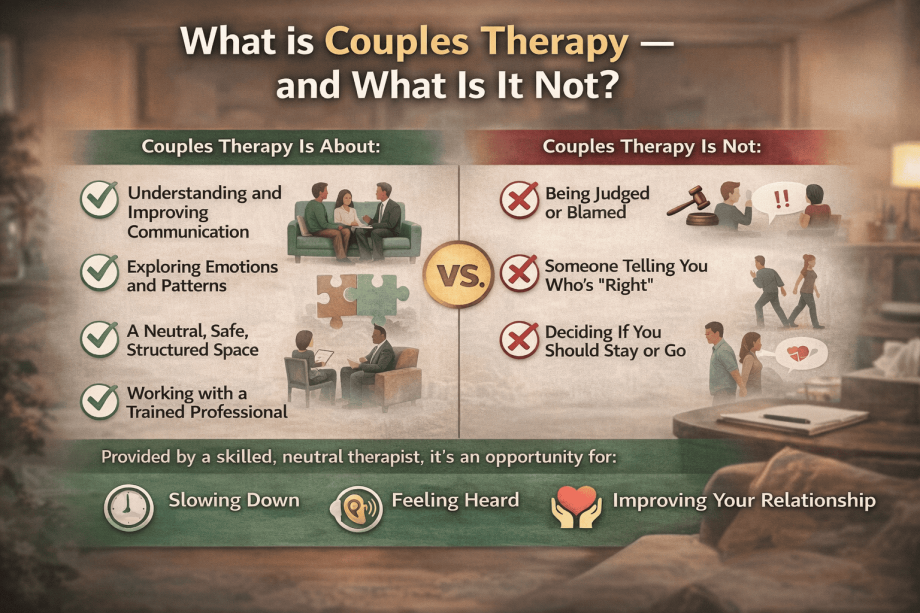
Couples therapy is a form of professional support in which two partners work with a trained therapist to understand and improve their relationship. It is not about being judged, having your relationship dissected, or being told whether to stay or leave. A skilled therapist holds no position on that question.
What therapy does offer is a structured space — one where both partners can slow down, say what they actually mean, and begin to hear each other more clearly. Many couples find that a neutral, experienced third party changes something that couldn’t be shifted through conversation alone.
One finding that tends to surprise people: on average, couples wait six years after problems first emerge before seeking support.⁵ By that point, patterns can be deeply ingrained and emotional injury has often accumulated. Starting earlier, when difficulties are still forming, tends to produce better outcomes. That said, couples who come to therapy in considerable distress can and do make meaningful progress.
Only around 19% of couples experiencing significant difficulties ever seek professional support.⁶ The reasons are rarely indifference. More often they are logistical and emotional in equal measure — finding a therapist with availability, travelling to an appointment after an already long day, worrying that doing so means admitting something is seriously wrong. These are understandable barriers, and they are worth naming.
Success rates across well-established couples therapy models sit between 70% and 75%, with more than 90% of couples reporting improved communication and emotional wellbeing — even in cases where they ultimately separate.⁷ Separation, when it happens, is not always evidence of failure. Sometimes therapy helps a couple part with more clarity and less damage.
Online Couples Therapy: How It Works for Brighton and Hove Couples
For couples in Brighton and Hove, online therapy resolves most of the practical barriers that prevent people from getting support.
A session conducted over a secure video call — typically Zoom — can begin from your own home within minutes of finishing work. There is no parking to find, no waiting room, no journey home afterwards. For couples where one or both partners commute to London — with season ticket costs running upward of £5,600 a year, representing roughly 15% of median local wages³ — that calculation matters enormously. A session that would require leaving work early, travelling from the station, and returning late can use up whatever energy remained in the day. Online therapy removes that entirely.
Some couples attend from the same room. Others join separately if work schedules make that easier. Both work well. Sessions typically run for fifty to sixty minutes. The early sessions focus on understanding — what each partner is experiencing, what patterns keep repeating, what you are both hoping might shift.
A concern that comes up regularly is whether therapy over a screen is as effective as sitting in a room with someone. The evidence is clear on this. Around 70% of couples report meaningful positive outcomes from relationship counselling, and that figure holds across both in-person and online formats.⁷ A 2025 meta-analysis published in BMC Psychology found that online couples interventions produced significant increases in relationship satisfaction and measurable reductions in stress and anxiety.⁸
One reason for this is something researchers describe as the disinhibition effect. Many couples find it easier to speak honestly from their own home than in a clinical setting. The familiar surroundings lower defences. Partners who might shut down in an office environment often find words come more readily when they are on their own sofa, in their own space.
There are situations where in-person sessions have specific advantages — couples dealing with very high emotional intensity, or where physical presence supports the work in ways that matter. The Hove Counselling Practice offers both, allowing couples to move between formats based on what works in any given week.
Brighton and Hove’s Diversity and Why It Matters in Therapy
Brighton and Hove is one of the most socially diverse cities in the UK. The Health Counts 2024 survey found that 28% of residents identify as LGBQ+, and 5% identify as trans or non-binary — both figures significantly higher than regional and national averages.⁴ The city has long been a place people come to for community, and the relationships that form here reflect that extraordinary breadth.
For LGBTQ+ couples, finding a therapist who genuinely understands the specific pressures of their relationship matters. Not one who simply claims to be inclusive, but one who brings actual knowledge and attunement to the particular experiences that shape same-sex and gender-diverse partnerships. Online therapy meaningfully expands access here — couples can connect with practitioners who have specific experience with LGBTQ+ relationships regardless of where that practitioner is based.
The Health Counts survey also found that 19% of Brighton and Hove residents live with a disability.⁴ For those with mobility difficulties, chronic pain, or conditions that make travel unpredictable, the ability to attend a session without leaving home changes whether support is accessible at all. Online therapy is not a compromise in these situations — it is the appropriate format.
There is also growing demand for support from neurodiverse couples, particularly where one or both partners live with ADHD or autism. Brighton’s population includes a substantial number of people who received late diagnoses or who are working through what their neurotype means for their relationship without a great deal of available guidance. The right therapist can help both partners understand rather than pathologise those differences — an important distinction.
The Main Approaches to Couples Therapy
There is no single method of couples therapy. Different approaches suit different couples, different problems, and different working styles. Most experienced therapists draw on more than one model, fitting the work to the people in the room.
Emotionally Focused Therapy (EFT — Attachment-Based)
Developed in the 1980s by Dr Sue Johnson, Emotionally Focused Therapy — referred to here as EFT-attachment, to distinguish it clearly from the separate technique of EFT Tapping — is one of the most extensively researched couples therapy models available. It is grounded in attachment theory: the idea that human beings are wired for emotional connection, and that most relationship conflict is driven by unmet attachment needs rather than surface-level disagreements.
In practice, EFT-attachment helps partners identify the repetitive cycles they fall into — pursuing and withdrawing, criticising and shutting down — and understand the fear or hurt driving those cycles beneath the surface. As each person becomes able to express their deeper emotional experience more clearly, the pattern between them begins to shift.
Clinical trials show a 70–73% success rate in reaching couples therapy goals, with a 90% improvement rate overall.⁹ What stands out is that gains tend to persist: couples followed for two years after completing therapy continued to show increased relationship satisfaction and reduced attachment anxiety.¹⁰ This approach works particularly well online because it centres verbal and emotional expression, and many clients find the home environment supports that openness.
Cognitive Behavioural Couples Therapy (CBCT)
Cognitive Behavioural Therapy adapted for couples focuses on the relationship between thoughts, behaviours, and emotional responses. When partners hold distorted beliefs about each other — “they never listen,” “nothing I do is good enough” — those beliefs shape how conflict unfolds and can escalate what might otherwise be manageable disagreements into repeated damage.
CBCT is skills-based and structured. Couples learn to identify unhelpful thinking patterns, practise communication and problem-solving, and gradually replace negative behavioural cycles with more constructive ones. Research supports it as a highly effective treatment for communication difficulties and conflict management, with therapeutic gains lasting well beyond the end of treatment.¹¹ CBT also translates effectively to an online format, with evidence showing it is as effective over video as in person for the anxiety and low mood that frequently accompany relationship difficulties.¹²
The Gottman Method
The Gottman Method was developed following decades of detailed research into what distinguishes stable relationships from those heading toward breakdown. The research achieved over 90% accuracy in predicting relationship failure — not as a form of judgement, but as a means of identifying the specific patterns that erode partnerships over time.
The method’s central model, the Sound Relationship House, identifies nine components of healthy partnership: deep knowledge of each other’s inner lives, shared fondness and admiration, responsiveness to bids for connection, positive perspective, managed conflict, fulfilled life dreams, and shared meaning. Therapy uses assessment, education, and direct skills coaching to strengthen each of these areas.
Key to the model is the finding that healthy relationships maintain a ratio of roughly five positive interactions for every negative one. Contempt — distinct from criticism, involving seeing a partner as beneath you — is identified as the single strongest predictor of relationship failure.¹³ The practical tools of this method translate well to a screen-based format, and many couples find the framework gives them something concrete to hold onto between sessions.
Solution-Focused Brief Therapy (SFBT)
Solution-Focused Brief Therapy takes a different starting point from most other models. Rather than spending time cataloguing what is wrong, SFBT focuses on what is already working — identifying the couple’s existing strengths and building deliberately on those.
Sessions typically run over five to eight appointments. Around 70% of couples using this approach report achieving their stated goals within two months.¹⁴ It suits couples who want a clearly structured, time-limited process and who find that focusing on what they want — rather than what they want to stop — is a more energising place to begin. For Brighton couples managing limited time and financial resources, the shorter-course model is worth knowing about.
Cognitive Behavioural Therapy (CBT) — Individual Strand in Couples Work
CBT as an individual modality is frequently integrated into couples work, particularly where one partner’s anxiety, depression, or intrusive thinking is affecting the relationship. By helping the individual recognise and challenge unhelpful thought patterns, the relational environment often shifts as a result.
Dialectical Behaviour Therapy (DBT) Skills
DBT is centred on four skill areas: mindfulness, emotional regulation, distress tolerance, and interpersonal effectiveness. In couples work, DBT skills are particularly helpful where conflict escalates quickly, where one or both partners struggle to manage intense emotional states, or where past trauma affects how each person responds to difficulty. Its skills — especially around de-escalation and communication — are widely integrated by integrative therapists.
EFT Tapping (Emotional Freedom Technique)
EFT Tapping — also known as the Emotional Freedom Technique — is a distinct somatic intervention that should not be confused with Emotionally Focused Therapy. The two share an acronym but are entirely different in approach and application.
EFT Tapping involves gently tapping on specific acupressure points on the face, head, and body while verbally acknowledging a distressing emotion or belief. The technique combines elements drawn from CBT, exposure therapy, and acupressure. It is used to reduce the emotional intensity associated with stressful memories, anxious thoughts, or body-held tension — and it works effectively in an online format, since it is self-administered with guidance from the therapist.
In the context of couples work, EFT Tapping can reduce the emotional charge that prevents genuine engagement in sessions, lowering the reactive state that leads to shutdown or escalation. A clinical trial found anxiety reduced by 37% and depression by 39% among participants in a relationship-focused EFT Tapping programme, alongside a 26% average rise in relationship satisfaction.¹⁵ EFT Tapping is validated as an evidence-based method across more than 100 clinical trials.¹⁶
It is worth noting that the scientific community holds varied views on the proposed mechanisms behind EFT Tapping, particularly the acupressure component. The psychological elements — cognitive reframing, exposure, regulation of emotional arousal — are well-supported. Most researchers attribute its effects to these established mechanisms rather than to energy meridian theory.
Person-Centred and Humanistic Approaches
Person-centred therapy holds that people possess an innate capacity for growth and healing when offered the right conditions: empathy, authenticity, and unconditional positive regard from the therapist. In couples work, this translates to a space in which both partners feel fully heard without judgement — often for the first time. Many integrative therapists use person-centred principles as the relational foundation of their practice while drawing on other models for specific interventions.
Transactional Analysis
Transactional Analysis gives couples a framework for understanding how people relate to each other through three ego states: Parent, Adult, and Child. These are not value-laden categories but descriptions of emotional and behavioural states that each person shifts between — often unconsciously.
In couples work, TA can illuminate why a conflict that starts as a practical disagreement rapidly becomes heated or one-sided. When one partner moves into a critical Parent state and the other into a defensive Child state, the Adult-to-Adult conversation needed to resolve the problem becomes unavailable. Therapy helps couples recognise these patterns and develop more balanced ways of engaging.
Psychodynamic and Attachment-Based Approaches
Psychodynamic therapy attends to how early relational experiences — with caregivers, family, and formative relationships — shape how adults form and maintain partnerships. Unresolved early experiences often emerge in the present relationship in ways that feel confusing or disproportionate. Attachment theory, often integrated with psychodynamic work, looks specifically at how early patterns of connection and security influence how a person relates to intimacy, conflict, and emotional dependency in adult life.
EMDR in Couples Contexts
Eye Movement Desensitisation and Reprocessing (EMDR) is primarily an individual trauma therapy, recommended by NICE for the treatment of PTSD. In couples contexts, it is increasingly used to help one or both partners process past relational injuries — including affairs, episodes of emotional harm, or childhood trauma — that continue to affect the relationship in the present. Research examining the integration of EMDR with EFT-attachment couples work found that clients became better able to regulate their emotional responses, leading to improved engagement in sessions and more secure bonding.¹⁷
Common Challenges Couples Bring to Therapy
Communication and Conflict
Communication breakdown is cited as the single most common reason couples seek therapy.¹⁸ In Brighton and Hove, where financial pressure, long commutes, and depleted evenings are all contributing factors, that breakdown often accelerates in ways that feel bewildering.
This is rarely about vocabulary. It is more often about the accumulated weight of feeling unheard, the patterns of avoidance or escalation that develop over time, and the way both partners can be entirely sincere in their distress while still talking past each other. Therapy attends to what prevents genuine communication in the first place: shame, fear of rejection, the exhaustion of repeated injury.
Three things that can help before or alongside therapy:
1. Introduce a speaking and listening structure for difficult conversations. Choose a time when neither of you is already stressed or pressed for time. One person speaks for five minutes without interruption — not to argue a case, but to say what they are actually feeling and why. The other person’s only job during that time is to listen. No counter-argument, no corrections. When the speaker finishes, the listener reflects back what they heard in their own words. Then swap. The goal is not resolution in a single conversation. It is the experience of feeling heard.
2. Notice what happens in your body just before conflict escalates. Many couples find that by the time they are in a full argument, they are no longer able to hear each other. The physiological state of being flooded — heart rate up, breathing shallow, thoughts racing — closes down the part of the brain most capable of empathy. If you can learn to recognise your own early warning signs, you give yourself the option to pause before the conversation tips somewhere neither of you wants to be. Agreeing a simple signal between you — a word, a gesture — to call a twenty-minute break can make a meaningful difference.
3. Separate the problem from the person. Many arguments carry an implicit message: you are the problem. Framing the same issue differently — “we have a problem with how we talk about money” rather than “you are impossible about money” — places both of you on the same side of it. This is harder than it sounds in the moment, but practising it in lower-stakes conversations first makes it more available when things get harder.
Emotional Distance and Disconnection
Many couples arrive in therapy not in open conflict, but in quiet estrangement. The arguments have stopped, but so has the closeness. Life — work, children, screens, exhaustion — has gradually filled the space where intimacy used to be. For couples in Brighton and Hove managing dual careers, high housing costs, and the relentless forward motion that city life demands, this kind of gradual drift is particularly common.
This distance is not evidence that the relationship is over. It is usually evidence that it has been running on autopilot for longer than either person realised.
Three things that can help before or alongside therapy:
1. Reintroduce small, deliberate bids for connection. Gottman’s research found that the health of a relationship is largely determined not by grand gestures but by how consistently partners respond to each other’s small everyday moments of reach — a comment, a shared observation, a touch on the arm.¹³ You do not need to manufacture sentiment. Simply paying attention to the small moments your partner reaches toward you — and responding to them, even briefly — begins to rebuild the texture of connection.
2. Spend time together that is not functional. Many couples spend time in the same space but in parallel — each managing their own tasks or screens. Making even thirty minutes a week that has no agenda — not catching up on logistics, not planning, not scrolling — creates conditions for actual contact. It does not have to be romantic. It just needs to be present.
3. Ask a question you do not already know the answer to. Gottman calls this “building love maps” — staying genuinely curious about your partner’s inner world rather than assuming you already know it.¹³ What are they worried about at the moment? What has been weighing on them? People change over time, and so do their preoccupations and fears. Asking with real curiosity signals that you are still interested in who they are.
Financial Strain and Relationship Stress
In Brighton and Hove specifically, financial pressure deserves its own attention. When 46% of income goes on rent, when house prices are out of reach for most, when the cost of living has left the average resident £2,000 worse off per year in real terms, the stress of money becomes a constant presence in relationships.¹’²
Couples argue about money more than almost anything else — but financial arguments are rarely only about money. They carry deeper content about safety, fairness, trust, and differing views of the future. One partner’s risk-tolerance may feel to the other like recklessness. One person’s caution may feel to the other like control. Therapy can help separate the practical disagreement from the emotional freight it is carrying.
Three things that can help before or alongside therapy:
1. Separate facts from feelings before any money conversation. Before discussing a specific financial decision or problem, each person names how they are feeling about money at the moment — not the specific issue, but their emotional state going in. Anxious. Resentful. Hopeful. Worried. Getting the emotional context visible before the practical discussion reduces the chance of one bleeding, unacknowledged, into the other.
2. Identify what money means to each of you, not just what the numbers say. For many people, money represents security, freedom, control, or status — and those meanings often differ between partners. A brief, unhurried conversation in which both partners talk about what financial security means to them, and what their relationship with money was like growing up, can surface the underlying beliefs that shape how disagreements about money actually feel.
3. Agree a practical framework together, then review it. Whether it is how you divide expenses, how you make decisions about larger purchases, or how you save — having a jointly agreed framework removes the need to negotiate the same ground repeatedly. The framework will need updating as circumstances change. Building in a regular, calm review (not a crisis conversation) means it stays relevant rather than becoming a source of resentment.
Infidelity
An affair lands differently on each person who experiences it. For the partner who discovers it, the initial response often resembles trauma — intrusive thoughts, hypervigilance, a sense that the ground has shifted beneath them. For the person responsible, there may be guilt, shame, confusion about what the affair meant, and fear about the future.
Therapy for infidelity requires particular care. The most effective models address the emotional crisis first — before any attempt to make sense of what happened or to move toward repair.¹⁹ Research consistently shows that disclosure matters: couples in which the infidelity was acknowledged and worked through in therapy had significantly better five-year outcomes than those in which secrecy was maintained.²⁰
Infidelity couples who remain together and complete structured therapy tend, over time, to report relationship satisfaction comparable to non-infidelity couples who also stayed together — a finding that will surprise many people, but which the longitudinal data supports.²¹
The following steps are offered with care, recognising that the acute aftermath of an affair is not a situation where a checklist is appropriate. They offer a sense of where early ground might be found — not a route map through what is inherently a complex and personal process.
Two things that may help as an initial orientation:
1. Give the immediate emotional crisis space before attempting to problem-solve. In the days and weeks after disclosure, the partner who has been hurt needs to be able to say what they are experiencing without it being managed, minimised, or rushed toward resolution. The instinct of the person responsible is often to want to fix things quickly — to reassure, explain, or ask for forgiveness. That instinct, however well-intentioned, can feel to the hurt partner like their pain is being shut down before it has been heard. If the two of you can agree to a period — even a few weeks — in which the focus is on allowing the hurt to be expressed rather than answered, that alone can prevent further damage.
2. Seek professional support sooner rather than later. This is one area where the practical step most likely to help is finding a qualified therapist experienced in working with affairs. The patterns that form in the months immediately after discovery — cycles of questioning, reassurance, withdrawal, and re-injury — can become entrenched quickly. Early support with a skilled practitioner is the most direct route to a better outcome, whatever that outcome turns out to be.
Addiction and Its Effects on the Relationship
When one partner is living with addiction — whether to alcohol, substances, gambling, or other behaviours — the relationship is affected in specific and recognisable ways. The partner without the addiction often describes exhaustion, hypervigilance, a loss of trust in their own perceptions, and a gradual erosion of self in the effort to manage the situation.
Couples therapy in this context needs to hold both people without shame, and also without pretending that care has no limits. The person with the addiction may need individual support alongside or before couples work. The relationship cannot be a container for recovery alone — both people have needs that matter.
Two things that may help as a starting point:
1. Name what is happening without assigning blame. One of the most disorienting aspects of living alongside addiction is the way it erodes shared reality — conversations that go in circles, minimising, selective memory. If you are the partner affected by someone else’s addiction, finding a trusted person to talk to — a friend, a GP, a support group such as Al-Anon — can help you stay connected to your own experience when the relationship itself makes that difficult. Your wellbeing matters as much as your partner’s — not as a support resource, but as a person in your own right.
2. If you are the person with the addiction, consider what you can be honest about. Recovery rarely begins with a single decision. But one thing that consistently matters in relationships affected by addiction is honesty about the current reality — even partial honesty — rather than continued minimising. This is not about confession as performance. It is about giving your partner something real to respond to. Most partners are already aware, at some level, of what is happening. What exhausts them most is the gap between what they know and what is acknowledged.
Neurodivergent Couples
Neurodivergence — including autism, ADHD, or a combination of both — shapes how people communicate, process emotion, manage sensory experience, and meet their own needs. In couples where one or both partners are neurodivergent, misunderstandings can be frequent and persistent — not because either person lacks care or intelligence, but because they are wired to move through the world differently.
Brighton and Hove has a significant neurodivergent population, including many people who received late diagnoses or who are only beginning to understand how their neurotype has shaped their relationships over time. Research indicates that adults with ADHD are three times more likely to experience relationship breakdown than those without the diagnosis.²² For autistic partners, the “double empathy problem” — the idea that communication difficulties between different neurotypes reflect a mismatch rather than a deficit in one person — reframes many relational difficulties more accurately.²³
Effective therapy with neurodivergent couples begins with psychoeducation: understanding what each partner’s neurotype actually means for how they experience intimacy, conflict, and daily life. This is not about fixing difference — it is about translating it.
Three things that can help before or alongside therapy:
1. Learn about each other’s neurotype together. Reading or listening to accounts by neurodivergent people — particularly those who write about relationships from lived experience — can provide both partners with language the relationship may currently lack. Understanding that ADHD-related time blindness is not the same as not caring, or that an autistic partner’s need for routine is not a form of control, shifts the frame from what is wrong with you to how do you work — a significantly more useful question.
2. Make implicit expectations explicit. Neurotypical social conventions carry a great deal of unspoken expectation — about how affection should be shown, what support looks like, how conflict should be handled. In neurodiverse relationships, these unspoken rules can become a source of repeated hurt and confusion. Identifying a few specific situations that regularly cause friction and writing down what each person needs in those situations — as concretely as possible — removes some of the ambiguity these moments generate. It is not romantic, perhaps. But it works.
3. Protect repair as a shared practice. Misunderstandings will happen. In neurodiverse relationships, the question is less how to prevent them than how to recover from them without accumulating resentment. Agreeing in advance on what repair looks like for each of you — what helps you feel reconnected after a difficult moment — gives you both a route back that doesn’t depend on getting it right in real time.
New Parenthood
Becoming parents restructures a relationship in ways neither person can fully prepare for. Sleep deprivation, the redistribution of labour, altered intimacy, and the intensity of new responsibility all place pressure on the couple at exactly the moment when they have least capacity to tend to each other.
In Brighton and Hove, where space is limited and the cost of living is high, the pressures of new parenthood carry additional weight. Couples managing smaller homes near Preston Park or in the quieter streets behind Hove Lawns find that having a baby compresses an already stretched living situation. Couples who cohabit before marriage, those managing the transition to parenthood, and blended family arrangements are among the fastest-growing groups seeking couples therapy.²⁴
Three things that can help before or alongside therapy:
1. Audit the invisible labour, together. One of the most common sources of resentment in new parenthood is the sense — often accurate — that one partner is carrying more than the other, in ways that are not fully visible to the person carrying less. Writing down, together, everything that needs to happen in a week — including the mental labour of remembering, anticipating, and organising — tends to be a more effective conversation than arguing about any single task. The goal is not to apportion blame, but to make the full picture visible to both people.
2. Protect a small amount of non-parent time each week. Even an hour a week in which neither of you is primarily a parent — where you are two people who chose each other, rather than two people managing a shared project — matters. It does not have to be effortful or romantic. The point is that the couple relationship does not vanish entirely into the parenting relationship.
3. Talk about how you each feel, not just what you each need. New parenthood brings up emotions that can be difficult to voice — inadequacy, grief for the relationship you had before, loneliness within a busy household, fear, love of an intensity that can be overwhelming. What feels like an argument about who does the night feeds is often actually an expression of something much less specific: exhaustion, disconnection, a hunger to be seen as more than a functioning parent. Occasionally stepping back from the practical negotiation and asking each other how you are actually feeling tends to shift the temperature of the other conversations.
Long-Distance Relationships and Brighton’s Commuter Couples
For couples where one or both partners commute regularly to London, the logistical weight of maintaining the relationship — let alone attending in-person therapy — can feel prohibitive. A couple spending four hours a day on trains, arriving home depleted, rarely has the bandwidth for much more than getting through the evening.
Long-distance couples proper — where one partner lives away for extended periods — face the additional pressures of physical separation, compressed time together, and relational maintenance conducted largely through screens. Online couples therapy has grown substantially in this area, with research indicating effectiveness rates of 70–80% for virtual sessions, comparable to in-person work.²⁵
Two things that can help:
1. Create structure around connection. Spontaneous contact is harder across distance, and the absence of small daily moments that sustain closeness means that connection can start to feel effortful. Scheduling regular, protected time — not just practical calls but genuine, unhurried conversation — treats the relationship as the priority it is. It may feel overly deliberate at first, but most couples who maintain close bonds across distance have some version of this structure in place.
2. Be explicit about what you miss. Distance compresses what can be said, and many couples find themselves managing the logistics of separation while the emotional texture of missing each other goes unspoken. Being able to say, specifically, what you miss — not just “I miss you” but what, precisely, you find yourself wanting — keeps emotional intimacy present even when physical closeness is not.
You Don’t Have to Be in Crisis to Come
There is a version of this story in which therapy is only for couples whose relationship is in serious trouble. That framing is neither accurate nor useful, and it stops a lot of people from getting support at a point when it would be most valuable.
Many couples who attend the Hove Counselling Practice are not on the verge of separation. They are couples who can feel something shifting — who notice they are not as close as they used to be, who keep having the same argument without it ever resolving, or who have been through something significant and want help processing it properly rather than hoping it fades on its own.
A walk along the Peace Statue end of Hove seafront, out past the beach huts and toward Shoreham, gives a particular kind of clarity — the sense that there is space to think. Sometimes that is what therapy offers too. Not solutions handed to you. Just space, and a skilled person to help you use it well.
How to Choose a Therapist
The evidence consistently shows that the quality of the relationship between therapist and client is a stronger predictor of outcome than any particular therapeutic model.²⁶ Finding someone you both feel comfortable with matters as much as their credentials, though credentials matter too.
When assessing a potential therapist, it is reasonable to consider:
- Qualifications and accreditation: Look for BACP accreditation (Accred status indicates a higher standard than basic membership), UKCP registration, or equivalent professional body membership. These bodies require practitioners to meet clear standards of training, practice, and ongoing supervision.
- Specialist training in couples work: Not all therapists who see individuals are trained in working with couples, which involves a distinctly different set of skills.
- Specific experience: If addiction, neurodivergence, or infidelity is part of your situation, a therapist with direct experience in that area will be better placed to help.
- Their approach and how they explain it: A good therapist will be clear about their working model and able to discuss how it might apply to your situation. Willingness to answer questions directly is a good sign.
- Online or in-person, and the flexibility between them: Both formats can be effective. Online therapy is often more accessible for couples managing work, childcare, or distance. In-person sessions may suit couples dealing with very high emotional intensity. A practice offering both — and the ability to move between them — is worth looking for.
The Hove Counselling Practice
The Hove Counselling Practice offers specialist couples therapy for people in Brighton, Hove, and across the UK via secure online sessions. The practice is led by Claire Sainsbury, BSc MA MBACP(Accred) — a BACP Accredited therapist with a Masters Degree in Counselling and Psychotherapy Practice, and an Advanced Postgraduate Diploma in Integrative Counselling and Therapy.
Claire’s training and clinical experience spans a broad range of therapeutic approaches. Her specialist qualifications include Advanced Level 3 Certification in EFT Tapping through EFT International — a body-based somatic technique useful for reducing emotional reactivity and processing held distress — as well as specialist training in couples work, CBT, and DBT. She is a DBT tutor at a London college and has worked extensively in addiction settings, bringing direct clinical experience with the complex interplay between compulsive behaviour, attachment, and relationship.
What clients describe, consistently, is a straightforward approach combined with genuine sensitivity. One client described the work as invaluable in helping to break through extremely damaging emotional patterns, noting that the practical techniques provided became the foundation for rebuilding trust. Another described attending sessions online when unable to travel to the practice in person, noting Claire’s flexibility as “very useful” and the overall experience as professional throughout.
The practice works with an integrative model — the approach is fitted to the couple and the presenting difficulty, drawing on whichever combination of methods is most relevant, rather than applying a fixed template to every relationship.
Face-to-face sessions are available at 126 Shirley Street, Hove, East Sussex — accessible by bus and train, with Hove and Aldrington stations nearby and on-street parking available. Online sessions are available across the UK via Teams. Appointments run Monday to Friday, 10am to 9pm.
Sessions begin with an assessment of your individual and relational needs, followed by a personalised plan drawing on the most relevant approaches for your situation.
If you are considering taking this step, or simply want to ask a question before committing to anything, you can get in touch via the contact form at thehovecounsellingpractice.co.uk/contact or by calling 07947 073298.
You don’t have to have it all figured out before you reach out. A conversation is often enough to begin.
References
- UK House Price Index / Rightmove Brighton and Hove data, 2024–2025.
- Office for National Statistics: Private Rental Market Statistics, 2025.
- Brighton and Hove City Council Economic Strategy Report / ONS Commuter Flow Data, 2024.
- Brighton and Hove Health Counts Survey 2024 (n=16,729 adults).
- American Association for Marriage and Family Therapy (AAMFT), cited in RelationshipsandMore.com. What Percentage of Couples Survive Couples Therapy. 2025.
- Relate / Marriage Foundation Research on Help-Seeking Behaviour in Couples, 2023.
- Gurman, A.S. & Snyder, D.K. Clinical Handbook of Couple Therapy, 5th Ed.; AAMFT data cited in MyDenverTherapy.com. Couples Therapy Statistics. 2025.
- BMC Psychology: Meta-analysis of digital couple interventions, 2025.
- Communicate and Connect. How Often Does Marriage Counseling End in Divorce? 2026; Johnson, S. et al. (1999). EFT meta-analysis, Journal of Marital and Family Therapy.
- Wiebe, S.A. et al. (2017). Two-Year Follow-up Outcomes in Emotionally Focused Couple Therapy. Journal of Marital and Family Therapy. PubMed PMID: 27997704.
- IntechOpen. (2018). Cognitive-Behavioral Psychotherapy for Couples: An Insight into the Treatment of Couple Hardships.
- NICE Guidelines: Evidence for CBT in online format for depression and anxiety, 2024.
- Gottman, J. & Silver, N. (1999). The Seven Principles for Making Marriage Work. New York: Crown.
- de Shazer, S. / SFBT outcome literature, including BRIEF UK research.
- Church, D. et al. Clinical trial on EFT Tapping Deep Intimacy programme, cited in EFT Universe. Relationship Therapy with EFT Counseling. eftuniverse.com.
- Church, D., Stapleton, P., Vasudevan, A. & O’Keefe, T. (2022). Clinical EFT as an Evidence-Based Practice. Frontiers in Psychology, 13, 951451.
- Cotter, P. et al. (2022). Thematic analysis of therapists’ experiences integrating EMDR and EFT in couple therapy. PMC PMC9544644.
- Gitnux. Couples Therapy Statistics: Market Data Report 2025. gitnux.org.
- Snyder, D.K. et al. (2008). Cited in Psychology Today. Infidelity in Relationships and Recovery in Couples Therapy. July 2025.
- Atkins, D.C. et al. (2005). Infidelity and Behavioral Couple Therapy: Relationship Outcomes Over 5 Years Following Therapy. American Psychological Association.
- New York Behavioral Health. Infidelity and Couple Therapy Outcomes. newyorkbehavioralhealth.com.
- Michielsen, M. et al. (2015). Cited in Psychology Today. 5 Game-Changing Strategies for Neurodivergent Couples. June 2024.
- Milton, D. (2012). The Double Empathy Problem. Cited in Thriving Family Therapy. Resources for Neurodiverse Couples. 2025.
- Gitnux. Couples Therapy Statistics: Market Data Report 2025, ibid.
- The Hove Counselling Practice. Online Therapy for Busy Couples in Brighton and Hove: Benefits Guide. Press release, February 2026.
- thehovecounsellingpractice.co.uk/about: “Research shows that having a connection with a therapist is more important than the type of therapy.”