Article At A Glance
- Emotional Freedom Technique (EFT Tapping) combines acupressure stimulation with cognitive therapy to reduce emotional flooding — making it one of the most practical tools available for couples in conflict.
- EFT Tapping is not the same as Emotionally Focused Therapy, despite sharing the acronym — understanding the difference helps couples choose the right support.
- Unresolved emotional reactivity is the hidden driver behind most relationship breakdowns, and EFT directly targets the nervous system responses that keep couples stuck.
- The Hove Counselling Practice integrates EFT Tapping within an advanced therapeutic framework that includes DBT, CBT, and complex trauma training.
- There is a specific three-phase trust revival process used after betrayal — and how EFT supports each stage may surprise you.
Most couples don’t argue because they stopped loving each other — they argue because their nervous systems never learned how to feel safe together.
When conflict becomes a cycle, when the same fight keeps happening with different words, that’s rarely a communication problem. It’s a nervous system problem. Emotional Freedom Technique (EFT Tapping) works directly at that level — calming the body’s stress response so that two people can actually hear each other, rather than just react. For couples in Brighton and Hove seeking something more than traditional talk therapy, this approach is opening new possibilities. The Hove Counselling Practice has been integrating EFT Tapping into couples work as part of a wider toolkit that treats the whole person, not just the presenting argument.
EFT Tapping Is Changing How Brighton Couples Heal
Relationships in crisis often reach therapy at the point of exhaustion — where both partners have tried talking, tried space, tried everything they know, and nothing has shifted the pattern. What EFT Tapping introduces is a body-first entry point into emotional healing, one that bypasses the mental loops couples get stuck in and goes straight to where the distress is actually stored.
Brighton and Hove is a vibrant, fast-moving city, and the pace of modern life here adds its own pressure to intimate relationships. The couples coming through the door at The Hove Counselling Practice aren’t failing at love — they’re overwhelmed, dysregulated, and often carrying wounds from long before this relationship began. EFT Tapping gives them a concrete skill to use, both in session and at home, that produces measurable, felt results from early on.
What Emotional Freedom Technique Actually Is
Emotional Freedom Technique is a somatic intervention that merges two powerful therapeutic traditions: cognitive exposure therapy and acupressure point stimulation. The foundational idea is straightforward — emotional distress isn’t just a mental experience, it’s a physiological one. When you feel anxious, ashamed, or triggered, your body responds with real physical signals: a tight chest, a racing heart, shallow breathing. EFT works by gently tapping on specific meridian points on the body while simultaneously naming and acknowledging the emotional experience.
The technique draws on a system of acupressure points used in Chinese medicine for over 2,000 years. By stimulating these points — located on the face, collarbone, under the arm, and on the hands — while holding a difficult emotion in mind, the body’s stress response begins to downregulate. The result isn’t suppression of the emotion. It’s the release of the charge around it, so the emotion can be processed rather than avoided.
The Science Behind Tapping on Acupressure Points
Research into EFT Tapping has grown substantially over the past two decades. Studies have measured significant reductions in cortisol — the body’s primary stress hormone — following EFT sessions. The mechanism appears to involve the amygdala, the brain’s threat-detection centre, which becomes less reactive when tapping is applied during emotional exposure. This is why EFT is increasingly being used not just for phobias and anxiety, but for trauma processing and relationship distress.
How EFT Differs From Traditional Talk Therapy
Talk therapy works top-down — you use language and insight to understand and reshape emotional experience. EFT works bottom-up, starting with the body and allowing cognitive shifts to follow naturally. This distinction matters enormously in couples work, where emotional flooding often makes meaningful conversation impossible. When a partner is flooded — heart rate elevated, thoughts racing, defensive walls fully up — no amount of skilled questioning will land. EFT creates the physiological conditions for dialogue to actually happen.

Why EFT Works Faster for Emotional Regulation
Speed of effect is one of EFT’s most clinically notable features. Because it directly targets the nervous system rather than working through layers of cognitive reframing, many clients report a noticeable shift in emotional intensity within a single session. For couples, this means less time spent in the escalation cycle and more time available for genuine connection and repair. It doesn’t replace the deeper relational work — but it creates the regulated state in which that work becomes possible.
Why Couples in Brighton and Hove Are Struggling
The reasons couples seek therapy are as varied as the couples themselves, but beneath the surface, the patterns are remarkably consistent. Unmet emotional needs, unspoken resentments, and nervous systems conditioned by early life experiences all show up in the room — usually disguised as arguments about chores, money, or parenting.
The Pressure of Modern Relationship Life in a Busy City
Brighton and Hove brings a particular set of pressures. High cost of living, demanding careers, social isolation despite busy social scenes, and the quiet attrition of screen-saturated evenings all erode the emotional bandwidth couples need to stay connected. Many couples arrive in therapy not because of a dramatic rupture, but because they’ve slowly drifted into parallel lives within the same home. The emotional distance that builds in those gaps is exactly what EFT Tapping is designed to address.
How Unresolved Conflict Quietly Erodes Emotional Bonds
Unresolved conflict doesn’t disappear — it sediments. Each argument that ends in shutdown or explosion without genuine repair leaves a residue of disconnection. Over time, partners begin to associate each other with threat rather than safety. The body remembers every unresolved rupture, and it starts to brace before conversations even begin. EFT Tapping works to clear this accumulated charge from the nervous system, giving couples a reset that talk alone rarely achieves.
How EFT Tapping Works Inside Couples Therapy Sessions
Inside a couples session using EFT Tapping, the approach looks different from what most people expect from therapy. There’s structure, there’s guidance, and crucially, there’s a clear physiological goal for each stage of the session. The therapist isn’t simply facilitating a conversation — they’re actively managing the emotional temperature of the room, using tapping sequences as a precision tool to bring both partners into a regulated enough state to do meaningful relational work.
Sessions typically begin with an assessment of each partner’s current emotional activation level. This isn’t abstract — partners are asked to rate the intensity of their distress on a concrete scale, which allows both the therapist and the couple to track shifts in real time. As tapping sequences are introduced, both partners can observe their own bodies responding, which itself becomes a powerful source of insight and shared experience.
The Role of the Therapist During Joint Tapping Sessions
The therapist’s role during joint EFT Tapping sessions is both clinical and relational. They guide the tapping sequence, help partners articulate the specific emotional content being targeted, and monitor both individuals for signs of overwhelm or dissociation. This requires a high level of training — which is why the integrative framework at The Hove Counselling Practice, combining EFT Tapping certification with qualifications in DBT, CBT, and complex trauma, is particularly well-suited to this work.
What Happens in the Body When Both Partners Tap Together
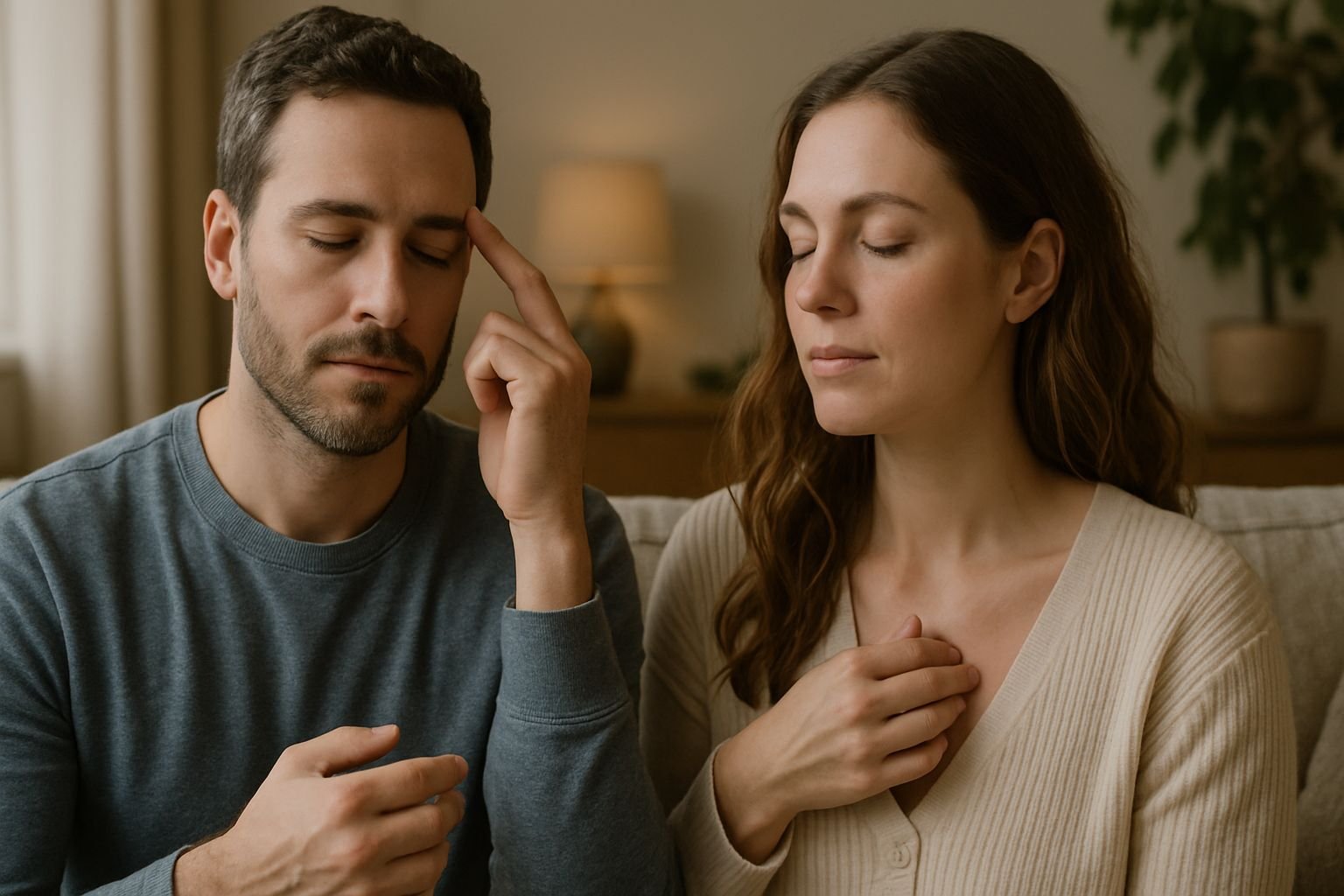
When two people tap simultaneously in the same space, something notable happens beyond individual regulation. There’s a co-regulatory effect — one partner’s nervous system begins to influence the other’s, in the same way that a calm presence can soothe an anxious one. This mirrors the attunement processes that secure attachment is built on. Partners who tap together in session often report feeling genuinely closer afterwards, not because they’ve resolved every issue, but because their bodies have briefly experienced safety in each other’s presence.
How EFT Targets the Root of Emotional Reactivity in Relationships
Most conflict in relationships isn’t actually about the topic of the argument. It’s about the emotional charge underneath it — the sense of not being seen, not being valued, or not being safe. EFT Tapping targets that charge directly. By stimulating acupressure points while naming the specific emotional experience, the intensity of the trigger begins to reduce. Over time, partners who practice this in session start to notice that the situations which once sent them into full reactive mode simply don’t have the same grip.
The Four Communication Patterns That Destroy Relationships
Relationship researcher John Gottman identified four specific communication behaviours that, when present consistently, predict relationship breakdown with remarkable accuracy. He called them the Four Horsemen: criticism, contempt, defensiveness, and stonewalling. Understanding these patterns is valuable, but understanding them while flooded with emotion is nearly impossible. This is precisely where EFT Tapping creates the opening — by lowering the physiological activation that makes these patterns feel automatic and unavoidable.
Criticism vs. Complaint: Why the Difference Matters
A complaint targets a specific behaviour: “I felt hurt when you didn’t call.” A criticism attacks the person’s character: “You never think about anyone but yourself.” The distinction sounds subtle, but the impact on the receiving partner’s nervous system is profound. Criticism triggers a threat response — the body reads it as an attack, not feedback, and defensive or shutdown behaviour follows almost automatically.
EFT Tapping helps here in two ways. First, it reduces the emotional charge the criticising partner carries, making it easier to access the vulnerability beneath the attack. Second, it helps the receiving partner lower their defensive arousal enough to actually hear what’s being communicated without their own system going into shutdown. The complaint becomes possible when both nervous systems feel safe enough to be honest.
How Contempt Becomes the Biggest Predictor of Breakup
Contempt is criticism with a superiority complex. Eye-rolling, mockery, sarcasm used as a weapon, dismissiveness — these behaviours communicate not just displeasure but moral superiority over a partner. Gottman’s research consistently identified contempt as the single strongest predictor of relationship dissolution. It is extraordinarily corrosive because it attacks the very foundation of mutual respect that intimacy depends on.
What drives contempt is almost always accumulated, unprocessed resentment. When grievances go unaddressed for long enough, they curdle into something harder. EFT Tapping, used consistently in therapeutic work, helps couples surface and process those older resentments before they calcify. The goal isn’t to excuse contemptuous behaviour — it’s to understand its emotional roots and dismantle the charge that feeds it.
Defensiveness and Stonewalling: What EFT Can Do About Them
Defensiveness is the nervous system’s attempt to protect itself from perceived attack. Stonewalling — complete emotional withdrawal from interaction — is what happens when that system becomes so overwhelmed it shuts down entirely. Both are physiological responses as much as psychological ones. Research shows that heart rates during stonewalling can exceed 100 beats per minute, meaning the partner who appears coldly disengaged is actually in a state of intense internal activation. EFT Tapping gives stonewalling partners a concrete physical action to perform during that overwhelm, interrupting the shutdown cycle and creating a pathway back into regulated engagement.
EFT for Couples Rebuilding Trust After Betrayal
Betrayal — whether through infidelity, financial deception, or a profound breach of confidence — creates what might be called trauma shadows in a relationship. The injured partner experiences intrusive thoughts, hypervigilance, emotional flooding, and a collapsed sense of safety that can feel indistinguishable from post-traumatic stress. Standard conversational approaches to rebuilding trust often fail at this stage because the nervous system of the injured partner simply cannot process reassurance when it’s running a constant threat-detection programme.
EFT Tapping enters this work as a stabilising force. Before the deeper relational repair can begin, both partners need a way to manage the acute physiological dysregulation that betrayal produces. The injured partner needs tools to interrupt the flooding cycle. The partner who caused the harm often carries their own intense shame response that, left unaddressed, actually impedes genuine accountability. Tapping creates regulated space for both.
Processing Emotional Flooding Caused by Infidelity
Emotional flooding after infidelity isn’t a choice — it’s a neurological event. The amygdala, now conditioned to associate the partner with danger, fires threat signals in situations that would previously have felt neutral: a delayed text reply, an unfamiliar name mentioned in conversation, a moment of emotional distance. EFT Tapping works directly with this amygdala hyperreactivity, reducing the intensity of the trigger response so the injured partner can begin to distinguish between genuine signals of ongoing risk and echoes of past trauma. This distinction is essential for any real healing to occur.
The Three Phases of Trust Revival: Atonement, Attunement, Attachment
Trust after betrayal doesn’t rebuild in a straight line, but it does tend to move through three recognisable phases. Atonement is the first — where the partner who caused harm takes full, undefended responsibility without minimising or rushing the injured partner’s pain. Attunement follows — where both partners gradually rebuild the capacity to read and respond to each other’s emotional states accurately, often for the first time. Attachment is the final phase — where the relationship reconstitutes itself around a new, more honest foundation. EFT Tapping supports all three stages by keeping both partners’ nervous systems regulated enough to stay present through the discomfort each phase demands.
Attachment Styles and Why They Shape Every Argument You Have
Your attachment style isn’t a personality trait — it’s a survival strategy your nervous system developed in response to your earliest experiences of emotional safety and threat. Formed in the first years of life through interactions with primary caregivers, these patterns become the blueprint your adult brain uses to navigate intimacy. The problem is that the blueprint was written by a child, in circumstances that may look nothing like your current relationship.
When two adults with different attachment strategies try to build a life together, the collision is often misread as incompatibility. It rarely is. It’s more often two nervous systems, each doing exactly what they were conditioned to do, speaking completely different emotional languages. EFT Tapping helps decode that collision by reducing the activation that makes each partner’s behaviour look like a personal attack rather than a protective pattern.
Anxious vs. Avoidant Attachment in Romantic Relationships
Anxiously attached partners tend to pursue connection under stress — they reach for reassurance, increase contact, and can become preoccupied with the state of the relationship when they feel uncertain. Avoidantly attached partners do the opposite — they withdraw, create distance, and prioritise self-regulation over shared processing. These two styles are dramatically over-represented in couples who seek therapy, and their pairing creates a painful dynamic: the more the anxious partner pursues, the more the avoidant partner retreats, and the more they retreat, the more the anxious partner escalates. EFT Tapping interrupts this cycle at the physiological level, giving both partners a moment of regulation before the pattern fully engages.
How EFT Helps Partners Recognise Each Other’s Attachment Needs
One of the most powerful shifts that happens through EFT-informed couples work is the moment a partner recognises that what looked like coldness or clinginess in their partner is actually a frightened attempt to feel safe. When tapping reduces the defensive charge around a behaviour, the vulnerability beneath it becomes visible. The avoidant partner can begin to see their withdrawal not as strength but as a learned protection. The anxious partner can begin to see their pursuit not as neediness but as a bid for connection. Once those underlying needs are named and felt — not just intellectually understood — the relationship has something real to build on.
Online Couples Therapy With EFT in Brighton and Hove
Geography no longer needs to be a barrier to quality couples therapy. For partners across Brighton, Hove, and the surrounding areas, online sessions at The Hove Counselling Practice deliver the same depth of therapeutic work as in-person appointments — including the full integration of EFT Tapping techniques.
Why Remote Sessions Produce the Same Results as In-Person Therapy
The core mechanisms of EFT Tapping don’t require physical proximity to a therapist. The tapping sequences are self-applied, the emotional processing happens within each partner’s own nervous system, and the therapist’s role — guiding, calibrating, and holding the therapeutic space — translates directly to a video format. Many couples actually find that being in their own home environment during sessions reduces the initial anxiety of entering therapy, allowing them to access genuine emotional material more quickly than they might in an unfamiliar clinical setting.
How Online Therapy Removes the Barriers Busy Couples Face
Scheduling is one of the most common reasons couples delay starting therapy. Coordinating two busy lives, finding childcare, navigating travel across the city — each logistical hurdle creates another opportunity to postpone the work. Online sessions remove most of those friction points entirely. A session can happen from a quiet room at home during a lunch break, after children are in bed, or between professional commitments, making consistent attendance far more achievable for couples who would otherwise struggle to maintain momentum in their therapeutic process.
Consistency matters enormously in couples therapy. The nervous system changes that EFT Tapping produces are cumulative — each regulated session builds on the last. Irregular attendance breaks that accumulation. By removing the logistical barriers, online therapy makes it significantly more likely that couples will complete a meaningful course of work rather than dropping out when life gets complicated.
What to Expect From Couples Therapy at The Hove Counselling Practice
The Hove Counselling Practice approaches couples therapy through an integrative framework that goes well beyond any single technique. Claire Sainsbury’s qualifications span Emotional Freedom Technique certification, Dialectical Behaviour Therapy, Cognitive Behavioural Therapy, and specialist complex trauma training — which means the therapeutic response is calibrated to the specific needs of each couple rather than applied as a one-size-fits-all protocol. An initial session is typically used to understand each partner’s history, identify the patterns driving current conflict, and establish a shared understanding of what the therapeutic work will involve. From there, sessions are structured to alternate between skill-building — including tapping sequences both partners can use independently — and the deeper relational work of rebuilding emotional safety and trust. Couples are given practical tools from the very first session, so the work doesn’t stay inside the therapy room.
EFT Tapping Is One of the Most Practical Tools a Couple Can Learn
What distinguishes EFT Tapping from many other therapeutic approaches is that it’s genuinely portable. Couples leave sessions with a concrete skill they can apply the moment emotional flooding begins — during a difficult conversation, in the middle of the night when anxiety spikes, or in the hours after an argument when the body is still holding the charge. That portability transforms therapy from something that happens once a week in a room to something that becomes woven into the daily texture of a relationship.
The goal of good couples therapy isn’t permanent dependency on a therapist — it’s building the internal and relational resources that allow two people to navigate difficulty together without catastrophic dysregulation. EFT Tapping is one of the most effective tools available for achieving exactly that. When both partners understand how their nervous systems work, what triggers their threat responses, and have a reliable technique for moving through emotional intensity without shutting down or escalating, the relationship changes at a fundamental level. Not because the hard moments disappear, but because the capacity to move through them together grows stronger every time they do.
Frequently Asked Questions
If you’re considering couples therapy with EFT Tapping and still have questions, the following covers what most people want to know before starting.
Is EFT Tapping Scientifically Proven to Help Couples?
EFT Tapping has a growing body of peer-reviewed research supporting its effectiveness for anxiety, trauma, and emotional regulation — the same mechanisms that drive relationship distress. Studies have demonstrated measurable reductions in cortisol levels following tapping sessions, and neuroimaging research points to reduced amygdala reactivity as a key mechanism. While couples-specific EFT Tapping research is still developing, the underlying science is well-established, and clinical outcomes in integrative couples therapy settings consistently reflect its value as a regulation tool.
How Many Sessions Does Couples Therapy With EFT Typically Take?
There’s no universal answer, because couples present at very different stages of distress and with very different goals. Some couples notice significant shifts within six to eight sessions, particularly when the primary issue is conflict escalation rather than deep relational trauma. Couples navigating betrayal, long-term emotional disconnection, or attachment wounds rooted in childhood typically benefit from a longer course of work.
What matters most is consistency and genuine engagement from both partners. EFT Tapping accelerates the regulation process, which can compress timelines compared to purely talk-based approaches — but the relational rebuilding still takes the time it takes. Your therapist will review progress regularly and adjust the approach as the work evolves.
Can We Do EFT Tapping at Home Between Therapy Sessions?
Yes — and this is one of EFT Tapping’s most practical advantages for couples. Once the basic tapping sequence has been introduced in session, both partners can use it independently whenever emotional intensity rises. This might look like individual tapping before a difficult conversation, tapping together when an argument begins to escalate, or using the technique during the anxious hours after a rupture when sleep feels impossible. Home practice between sessions significantly amplifies the progress made in therapy and helps couples build genuine skill rather than remaining reliant on the therapist’s presence to achieve regulation.

Is Couples Therapy With EFT Suitable if One Partner Is Reluctant?
Reluctance is extremely common, and it rarely means the therapy won’t work. Partners who feel pushed into therapy by the other often arrive with their defences fully activated — which is itself important clinical information about how they manage perceived threat. A skilled therapist will meet that reluctance without pressure, creating enough safety in the first session for even a sceptical partner to begin to engage.
EFT Tapping can actually be a useful bridge for reluctant partners precisely because it’s physical and practical rather than purely introspective. Partners who find traditional talk therapy abstract or uncomfortable often respond more readily to a technique that produces a tangible, felt shift quickly. The experience of noticing their own emotional intensity reduce within a single session tends to be more persuasive than any intellectual argument for why therapy is worthwhile.
If one partner remains genuinely unwilling to attend, individual sessions can still create meaningful change in the relational dynamic. When one person in a system shifts their patterns, the system itself shifts. Therapy with one partner is not a compromise — it’s still a valid and often highly effective path forward.
How Is EFT Tapping Different From Emotionally Focused Therapy in Couples Work?
This is one of the most frequent points of confusion, entirely understandable given that both approaches share the acronym EFT. Emotional Freedom Technique (EFT Tapping) is a somatic, body-based technique rooted in energy psychology and acupressure. It involves physically tapping on specific meridian points while naming emotional experiences, with the goal of reducing nervous system activation and releasing the charge around difficult emotions.
Emotionally Focused Therapy, also abbreviated as EFT, is a structured therapeutic model developed by Dr. Sue Johnson and rooted in attachment theory. It works through guided emotional disclosure, identifying negative interactional cycles, and helping partners express their deeper attachment needs to each other. It doesn’t involve any physical tapping and operates primarily through language, insight, and relational dialogue.
Both approaches have strong evidence bases and both address emotional experience in relationships — but they work through completely different mechanisms. At The Hove Counselling Practice, EFT Tapping is integrated as a somatic regulation tool within a broader integrative framework, meaning it works alongside cognitive and trauma-informed approaches rather than in isolation. If you’re unsure which approach your therapist uses, it’s always worth asking directly so you arrive in session with a clear understanding of what the work will involve.
The Hove Counselling Practice offers specialist integrative couples therapy, combining EFT Tapping with advanced trauma-informed and cognitive approaches to help Brighton and Hove couples move from chronic conflict to genuine connection.