Too many people today are managing problems related to body image, relationships, anxiety and depression through eating disorders that are life threatening. In this piece, the CEO of the National Eating Disorders Association in the US describes her own experience of disordered eating as a teenager and how this has led to her forging a career within the field, to reach out to others who are suffering as she has:
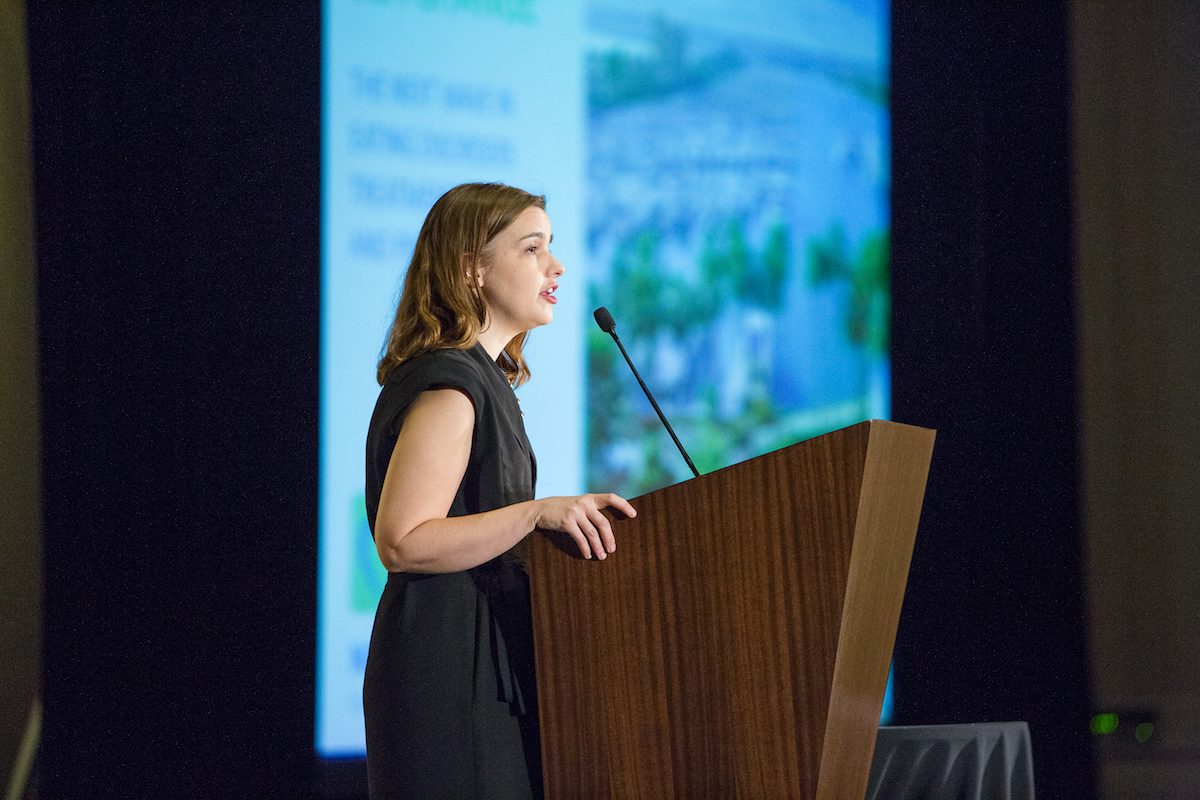
Eating disorders affect people of all ages, sexes, sexual orientations, races, sizes, and socioeconomic status, and have a serious physical and psychological impact. After dealing with her own struggles, Claire Mysko, the CEO of the National Eating Disorders Association, has dedicated her career to raising awareness and helping others.
Mysko was in seventh grade when she first started exhibiting troubling behavior: The 11-year-old and her classmates had started to experiment with dieting. “That was very appealing to me at the time. I have a lot of the traits associated with eating disorders—perfectionism being one of them—and I was also just feeling a lot of insecurity about my body at that time.”
Body image concerns can be crippling for many young people who struggle to accept themselves when they believe they are far from the glamourized ideal promoted by the modelling culture for example. Shaming for being “fat,” “not pretty enough,” “too tall,” “too short,” having the wrong hair colour,” etc…etc… is a sad depiction of a young person’s potential reality on the school or college playground as well as the world of fashion.
Like many others today, the start of Claire Mysko’s disordered relationship with her body started with her dieting …
Once she began, her dieting started to spiral out of control. She started tracking what she was eating, recording calories consumed, and exercising compulsively. Mysko also kept a folder of magazine pictures of thin models whose form she strived to emulate. “I still remember that very clearly of thinking and believing that if I could just achieve this look that I would feel better about myself, and that I would be happier, and that my life would be better, I would have more friends.”
How desperately sad it is, that the plight of so many young people today has become the need to focus on thinness at the cost of all other aspects of life. It is ironic that this perception of enhanced popularity can indeed be perceived as a slow path to death. For example “Anorexia nervosa has the highest death rate of any psychiatric illness (including major depression.” http:/www.mirasol.net
When Mysko started to lose a little bit of weight, she began to get positive reinforcement about her dieting and exercising. Once she lost more and more weight, her father, who was a doctor, and her mother, a nurse, became concerned. Mysko’s physician diagnosed her with an eating disorder and referred her to a psychologist who had experience in the field. Unfortunately, her anorexia developed into bulimia once she entered high school. However, she continued to seek and receive treatment.
Many eating disorders morph into another form of disordered eating. It is not uncommon for the rigid and restrictive patterns of anorexia to evolve into binge eating or bulimia nervosa or a variant of these.
“For me once I started to eat ‘normally’ I felt very out of control. My sense of my own appetite was so off base at that point because I was so used to restricting. I didn’t know when I was hungry and when I was full anymore,” Mysko explained. Mysko began binge eating to nourish herself, but then started purging when the idea of gaining weight terrified her. It was at this point she realized there was a serious problem.
During her freshman year of college, Mysko had been managing her eating disorder well. However, she had a relapse where she was binging and purging multiple times a day. “That was a turning point for me,” Mysko said. “When I was able to say for myself ‘I don’t want this eating disorder anymore. I don’t want to live like this. I can’t manage this. It’s not something I can do on my own.’” (Living with an eating disorder can be like living with a dysfunctional partner where a person becomes dependent overtime with increasing lack of control and little capacity to change). “I was very isolated when I was struggling. There was a lot of secrecy, a lot of shame. I was very good at hiding my behavior, and kind of putting on this brave face like everything was okay, and ‘I’ve got everything under control.’
Recovery begins when a person feels able to start reaching out for help by telling the truth and beginning to be open about what is happening to them. This may be very frightening to many sufferers because they will be letting go of something that they perceive as a lifeline.
Mysko continues…“So for me a big part of my recovery and getting over my eating disorder was learning how to let my guard down, and ask for help, and let people into my life in a much more authentic way,” Mysko called her parents in tears, got on a bus and went home. With her parents’ support she found additional treatment, and it was the first time she took ownership of her own recovery process. She had learned how to reach out for help and support when she needed it.
Mysko adopted healthier coping skills because her eating disorder had partly been a way to deal with underlying anxiety and depression. She learned how to think about exercise as something healthy and enjoyable instead of a way to achieve the perfect body. Her personal experience and triumph ultimately inspired her to help others.
Changing the Culture of Eating Disorders and Body Image
Reaching out for help is the first step.
The Hove Counselling Practice offers specialised eating disorder treatment in Brighton and Hove to people struggling with Anorexia, Bulimia, Binge Eating, Overeating and other variations of these eating disorders.