Key Takeaways
- Alexander Pope’s “Ode on Solitude” offers revolutionary insights for modern relationships despite being written over 300 years ago
- Research confirms Pope’s intuition: couples who maintain healthy independence report greater relationship satisfaction
- Embracing solitude paradoxically strengthens connection, creating a foundation for more authentic intimacy
- Creating “solitude spaces” in relationships helps partners develop individual identities while deepening their bond
- Finding the balance between togetherness and separateness is essential for relationship longevity and growth
In our hyperconnected world, couples increasingly find themselves more digitally tethered yet emotionally distant than ever before. This paradox of modern romance—where we’re constantly in touch but rarely truly connecting—creates a silent relationship crisis that many couples experience but struggle to name. Alexander Pope’s “Ode on Solitude,” written remarkably when he was just twelve years old, offers profound wisdom that can transform how we approach romantic connections today. Through its elegant simplicity, this 18th-century poem provides a blueprint for maintaining healthy boundaries and individual identity while fostering deeper intimacy.
The constant notifications, work emails, and social media updates that characterise modern life leave little room for the kind of quiet reflection Pope celebrated. Many couples spend their evenings physically together but mentally elsewhere—scrolling through separate digital worlds while sitting side by side. This technological togetherness creates an illusion of connection while actually preventing the deeper intimacy that emerges when two whole individuals choose to share their lives.
The Silent Crisis in Modern Relationships: Why We’re More Connected Yet Lonelier Than Ever
Today’s couples face unprecedented challenges to genuine connection. We text throughout the day, share location data, and maintain digital presence in each other’s lives 24/7—yet many report feeling profoundly lonely within their relationships. This phenomenon, which therapists increasingly identify as “together loneliness,” stems from confusing constant contact with meaningful connection. Many partners find themselves living parallel lives under the same roof, maintaining surface-level interactions while missing opportunities for deeper emotional intimacy and understanding.
The statistics paint a concerning picture: relationship satisfaction has been declining steadily over recent decades despite our increased ability to stay connected. Studies show that couples who report the highest levels of digital connection often experience the lowest levels of emotional intimacy. This contradiction reveals that something essential is missing from our understanding of healthy attachment—something Alexander Pope intuited centuries ago when he wrote about the value of peaceful solitude.

The Lost Art of Being Alone: What Pope’s Poetry Teaches About Healthy Attachment
“Happy the man, whose wish and care
A few paternal acres bound,
Content to breathe his native air,
In his own ground.”
– Alexander Pope, “Ode on Solitude”
Pope’s opening stanza captures a revolutionary concept for modern relationships: contentment within one’s own boundaries creates the foundation for genuine connection. Unlike today’s relationship models that often emphasise constant togetherness and complete transparency, Pope suggests that maintaining healthy boundaries—having “a few paternal acres” of one’s own—creates the psychological space necessary for authentic connection. This doesn’t mean emotional distance but rather a healthy sense of self that exists independently from the relationship.
Modern attachment theory confirms Pope’s intuition. Secure attachment doesn’t mean dependence or constant togetherness but rather the confidence that comes from knowing both partners can function independently while choosing connection. The healthiest relationships balance togetherness with separateness, creating what therapists call “differentiation”—the ability to maintain your sense of self while in close relationship with another.
Who Was Alexander Pope and Why His 300-Year-Old Poem Matters Today
Alexander Pope (1688-1744) stands as one of England’s most celebrated poets, known for his satirical wit and philosophical depth. What makes his wisdom on solitude particularly remarkable is that he wrote “Ode on Solitude” as a child, displaying an intuitive understanding of human psychology that would take science centuries to confirm. Despite physical challenges (Pope suffered from Pott’s disease which stunted his growth and caused lifelong health problems), he developed exceptional insight into the human condition, particularly the importance of internal contentment rather than external validation.
Though writing long before the age of smartphones and social media, Pope identified a timeless human tendency to seek validation and fulfilment outside ourselves—whether through social status in his era or through likes and followers in ours. His poem speaks directly to the modern struggle to maintain authentic connection in an age of constant distraction and performance. The fact that these insights come from the 18th century reminds us that our need for both connection and solitude isn’t new—it’s fundamental to human psychology regardless of technological context.

The Central Message of “Ode on Solitude”
At its heart, Pope’s “Ode on Solitude” celebrates self-sufficiency and quiet contentment as the foundations of a meaningful life. The poem presents solitude not as loneliness or isolation but as a state of peaceful self-possession where one can “study with ease and leisure” and live “unknown to fortune and fame.” This vision directly challenges our modern emphasis on constant connectivity and external validation, suggesting instead that true fulfilment comes from developing an internal sense of worth and purpose.
- Contentment with simplicity rather than endless pursuit of more
- Finding peace within one’s own boundaries rather than constant external stimulation
- Valuing quiet reflection over constant social engagement
- Appreciating deep, meaningful experiences rather than numerous shallow ones
- Cultivating self-knowledge before seeking to know others
When applied to relationships, these principles suggest that the healthiest connections form between individuals who have first established their own internal sense of peace and purpose. Rather than looking to a partner to “complete” them or provide constant entertainment and validation, Pope’s vision suggests that the most fulfilling relationships emerge when two self-sufficient individuals choose to share their already-complete lives. This represents a profound shift from the codependent model that dominates many modern relationships, where partners expect each other to be the primary source of fulfilment and identity.
The Paradox: Stronger Apart to Grow Stronger Together
Perhaps the most counterintuitive aspect of Pope’s vision is what relationship therapists now call the “intimacy paradox”—the principle that meaningful connection requires healthy separation. In modern relationships, many partners fear any form of separateness, interpreting a desire for solitude as rejection or lack of love. Yet Pope’s poem suggests that maintaining boundaries and personal space actually creates the foundation for deeper connection. When we’re secure in our own identities and capable of finding contentment independently, we bring more authentic presence to our relationships.
5 Relationship-Transforming Lessons from “Ode on Solitude”
Pope’s seemingly simple poem contains revolutionary insights that can transform how modern couples relate. By examining the poem’s core principles through the lens of contemporary relationship psychology, we discover practical wisdom for navigating the complex terrain of modern love. These lessons offer a roadmap for couples seeking both deeper connection and individual fulfilment.
1. True Contentment Comes From Within, Not Your Partner
When Pope writes of being “happy” with “a few paternal acres,” he’s articulating what modern psychology confirms: external circumstances—including romantic relationships—cannot create lasting happiness if we lack internal contentment. Many relationships falter under the impossible expectation that a partner should provide complete fulfilment. This burden creates resentment and disappointment when the inevitable limitations of human connection emerge. By developing what therapists call “self-soothing”—the ability to manage our own emotional states—we free our partners from the impossible task of being our everything.
Research consistently shows that couples with the highest satisfaction are those where both partners maintain individual interests, friendships, and sources of fulfilment outside the relationship. Rather than creating distance, this self-sufficiency establishes the emotional security necessary for genuine vulnerability and connection. When we’re not desperately seeking validation from our partners, we can be present with them in more authentic ways.

2. Simplicity Creates Space for Authentic Connection
Pope celebrates a life “whose trees in summer yield him shade, in winter fire,” emphasizsng the sufficiency of simple pleasures rather than constant novelty and stimulation. Modern couples often fall into the trap of seeking ever-increasing excitement—whether through elaborate date nights, extravagant vacations, or constant social activities—while neglecting the profound connection that emerges in quieter moments. The poem reminds us that meaningful intimacy often flourishes in simplicity, when we’re not distracted by external stimuli.
This principle has particular relevance in our digital age, where many couples spend their “together time” distracted by separate screens. By creating technology-free spaces and embracing simpler forms of togetherness, partners often discover deeper connection. The quiet evening walk, the un-rushed conversation over morning coffee, the shared silence of reading side by side—these simple experiences create the psychological space where genuine intimacy can flourish.
3. Self-Sufficiency Strengthens Your Love Bond
Pope describes the ideal life as one where a person can “labor till the work be done, with his own hands.” This emphasis on self-sufficiency translates powerfully to modern relationships, where dependency often masquerades as love. When partners develop the capacity to manage their own emotional needs, practical responsibilities, and personal growth, they create a relationship founded on choice rather than necessity. This shift from “needing” to “choosing” transforms the quality of connection.
Couples who embrace this principle report feeling both more secure and more excited about their relationships. The knowledge that your partner chooses to be with you rather than depending on you creates a foundation of trust and mutual respect. It also preserves the element of mystery and appreciation that often fades when partners become extensions of each other rather than distinct individuals who continually choose connection.
4. Finding Peace in Your “Own Ground” Before Sharing It
One of Pope’s most striking images is that of being content “in his own ground”—suggesting both literal space and psychological territory. For modern couples, establishing personal “ground” means developing a clear sense of identity, values, and boundaries before attempting to merge lives with another person. Many relationship difficulties stem from partners who haven’t done this foundational work, instead looking to relationships to define who they are.
Therapists increasingly emphasise the importance of what’s called “differentiation”—maintaining a solid sense of self while in close relationship. Couples with healthy differentiation can stay connected during disagreements without losing their individual perspectives, can support each other’s growth without feeling threatened, and can allow each other to change without fearing abandonment. This capacity begins with what Pope describes—finding peace in your own ground first.
5. The Joy of Being “Unobserved” Yet Deeply Known
Pope concludes his poem by celebrating a life “thus unnoticed and unknown” yet complete in itself. This seemingly contradictory desire—to be both unobserved and deeply known—captures the essence of healthy intimacy. In our social media age where performance and presentation dominate, many people never experience the freedom of being fully themselves without observation or judgment. Yet paradoxically, this capacity to be comfortably alone is precisely what enables the vulnerability necessary for deep connection.
The Science Behind Solitude: Why Pope Was Right All Along
What Pope intuited through poetic insight, modern psychology confirms through rigorous research. Studies increasingly demonstrate that the capacity for healthy solitude correlates strongly with relationship satisfaction and longevity. Far from being contradictory states, solitude and connection appear to strengthen each other when properly balanced.
The science of attachment has evolved dramatically in recent decades, moving from models that emphasised constant togetherness to more nuanced understandings of how secure connections actually form. Contemporary research shows that secure attachment doesn’t mean dependence or constant contact but rather the confidence that comes from knowing separation is safe and temporary. This security creates the foundation for both individual growth and relationship depth.
Modern Research Confirms the Power of Healthy Separation
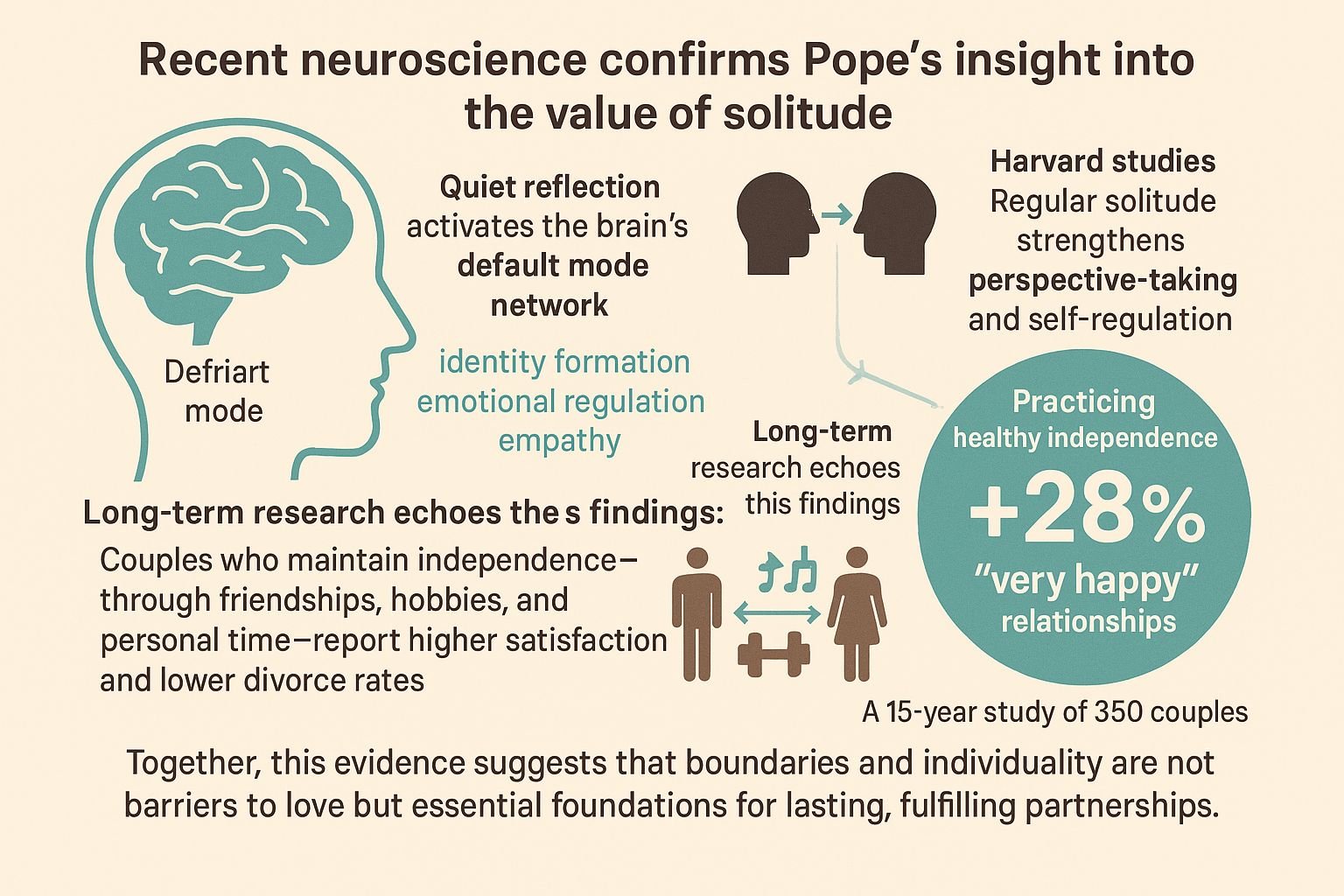
Recent neurological studies have uncovered fascinating evidence supporting Pope’s intuition about solitude. When individuals engage in periods of quiet reflection without external stimulation, the brain’s default mode network activates, facilitating crucial processes like identity consolidation, emotional regulation, and empathy development. These neural mechanisms quite literally build the psychological capacities that make deep intimacy possible. Researchers at Harvard University have demonstrated that regular periods of solitude strengthen the brain’s capacity for perspective-taking and emotional regulation—both essential skills for maintaining healthy relationships.
Longitudinal studies tracking couples over decades consistently find that those who maintain healthy independence throughout their relationships report significantly higher satisfaction and lower divorce rates than those who merge identities completely. One particularly compelling study followed 350 couples for 15 years and found that those who maintained individual friendships, separate hobbies, and regular solitude practices were 28% more likely to describe their relationships as “very happy” compared to couples who did everything together. This research confirms what Pope’s poem suggests—that healthy boundaries create the foundation for lasting connection.
The Psychological Benefits of Solitude for Relationship Health
Psychologists identify several specific mechanisms through which solitude enhances relationship quality. First, time alone allows for emotional processing and self-regulation, preventing the common pattern where unprocessed feelings get projected onto partners. Second, solitude creates space for reflection and perspective, helping partners distinguish between issues stemming from the relationship itself versus individual struggles they’re bringing to it. Third, periods of separation generate psychological space for desire and appreciation to regenerate, counteracting the familiarity that often diminishes romantic attraction over time.
Perhaps most importantly, solitude practices help individuals maintain what psychologists call “internal validation”—the capacity to assess and appreciate oneself without requiring constant external confirmation. This self-sufficiency creates the paradoxical effect of making genuine intimacy possible, as partners can share themselves authentically rather than seeking validation through their relationship. As Pope suggests, being “content to breathe his native air” creates the psychological freedom to truly connect with another without dependence or fear.
How to Create “Solitude Spaces” in Your Relationship
Translating Pope’s poetic insights into practical relationship strategies requires intentionality and communication. Many couples intellectually understand the value of healthy independence but struggle to implement it without triggering insecurity or feeling guilty. Creating what therapists call “solitude spaces”—physical, emotional, and temporal boundaries that honour individual identity—requires both practical arrangements and psychological adjustment.
Physical Spaces: Carving Out Room for Individual Growth
Even in shared homes, establishing designated areas for individual reflection and activity provides the psychological breathing room Pope celebrates. This might mean creating separate areas where each partner can pursue personal interests, maintaining individual workspaces, or simply respecting closed doors as boundaries. Some couples even maintain separate bedrooms while sharing rich emotional and physical intimacy, finding that this arrangement enhances both sleep quality and relationship satisfaction. The key is creating physical arrangements that value both connection and separation rather than prioritising one at the expense of the other.

Emotional Boundaries: The Gift of Not Always Sharing Everything
Contrary to popular relationship advice that emphasises complete transparency, research suggests that maintaining some emotional privacy actually strengthens intimate bonds. Healthy couples distinguish between secretiveness (which undermines trust) and privacy (which appreciates individual identity). This might mean processing certain emotions individually before bringing them to the relationship, maintaining private friendships and conversations, or having personal projects and goals distinct from shared ones. As Pope writes of the contented individual, “whose trees in summer yield him shade,” these emotional boundaries provide psychological shelter that ultimately enables more authentic connection. For more insights, explore modern relationship advice inspired by ancient wisdom.
Time Apart: Setting a Rhythm That Works for Both of You
Perhaps the most concrete way to implement Pope’s wisdom involves establishing regular periods of separation within the relationship rhythm. Successful couples report benefits from daily solitude practices (like morning meditation or evening walks alone), weekly individual activities (separate social engagements or hobby time), and occasional longer separations (solo travel or retreats). What matters isn’t the specific arrangement but rather the mutual understanding that these separations strengthen rather than threaten the relationship. When both partners recognise solitude as a gift they give each other rather than a rejection, it transforms from a potential source of insecurity to an act of love.
One approach that many couples find helpful is establishing “parallel play” periods—times when partners engage in separate activities while sharing space. This practice, borrowed from child development psychology, allows for individual focus while maintaining proximity. Whether reading separate books side by side, pursuing different creative projects in the same room, or simply enjoying quiet companionship without conversation, these experiences prize both connection and individuality simultaneously.
From Codependence to Independence: Real-Life Relationship Transformations
Couples who successfully implement Pope’s principles often report profound transformations in their relationship quality. By shifting from codependent patterns to healthy interdependence, they discover deeper intimacy alongside greater individual fulfilment. While the transition can initially feel threatening to partners accustomed to constant togetherness, the long-term benefits typically include reduced conflict, increased attraction, and more authentic connection.
The Warning Signs Your Relationship Lacks Healthy Solitude
Several patterns indicate that a relationship has become imbalanced toward excessive togetherness at the expense of individual identity. These warning signs include feeling anxious when separated, making decisions primarily to please the partner, losing interest in formerly enjoyable individual activities, declining invitations from friends to spend time with a partner, or feeling responsible for a partner’s emotional state. When these patterns emerge, introducing Pope’s principles of healthy solitude can revitalise both individual well-being and relationship quality.
Baby Steps: How to Introduce More Independence Without Threatening Connection
For couples accustomed to constant togetherness, implementing Pope’s vision requires gradual steps rather than dramatic changes. Beginning with short periods of separation—perhaps just an hour of solo activity—allows both partners to develop comfort with healthy boundaries. Open communication about the purpose of these changes helps prevent misinterpretation, framing solitude as a gift to the relationship rather than an escape from it. Couples who successfully navigate this transition often report initial discomfort followed by significant improvements in both individual well-being and relationship satisfaction.
One particularly effective approach involves creating what therapists call “reunion rituals”—specific ways of reconnecting after periods of separation that reinforce the security of the relationship. These might include brief check-ins, physical affection, or shared activities that reestablish connection. By developing predictable patterns of separation and reunion, couples learn that boundaries enhance rather than threaten intimacy, just as Pope’s poem suggests.

Finding Balance: When Too Much Solitude Hurts Your Relationship
While Pope’s “Ode on Solitude” celebrates the virtues of self-sufficiency, applying its wisdom to modern relationships requires balancing independence with connection. Excessive separateness can be just as damaging as codependence, leading to emotional disconnection and parallel lives rather than genuine intimacy. The goal isn’t maximising solitude but rather finding the optimal balance between togetherness and independence that allows both the relationship and the individuals within it to flourish.
Research on attachment styles provides important context for understanding individual differences in solitude needs. Partners with anxious attachment tendencies typically require more reassurance during separations, while those with avoidant patterns might use solitude defensively to prevent intimacy. Recognising these different comfort levels helps couples negotiate boundaries that respect both partners’ emotional needs rather than imposing a one-size-fits-all approach to relationship independence.
The poet’s emphasis on being “content to breathe his native air” doesn’t advocate isolation but rather suggests that true connection emerges from a foundation of self-sufficiency. Pope’s ideal isn’t complete separation but rather the capacity to find peace within oneself that can then be shared with another. This balance—being separate enough to maintain identity yet connected enough to experience deep intimacy—represents the golden mean of relationship health that most couples seek.
The Difference Between Healthy Space and Emotional Abandonment
Critical to implementing Pope’s wisdom is distinguishing between healthy solitude and emotional disconnection. The difference lies primarily in intention and communication—healthy space is transparent, mutually agreed upon, and ultimately serves the relationship, while abandonment is unilateral, unexplained, and serves only individual needs. Partners who successfully navigate this distinction maintain open dialogue about their needs for both connection and separation, recognising that these dimensions complement rather than contradict each other in healthy relationships.
Communication Strategies for Negotiating Alone Time
Perhaps the most crucial skill for implementing Pope’s principles is effective communication about solitude needs. Successful couples frame conversations about independence in terms of personal responsibility rather than rejection, using “I” statements that express individual needs without criticising the relationship. For example, saying “I need some quiet time to recharge so I can be more present when we’re together” communicates the positive intention behind separation better than “I need space from you.”
Timing these conversations appropriately also impacts their reception. Discussing solitude needs during calm, connected moments rather than during conflicts or immediately after reuniting helps partners hear these requests as relationship investments rather than rejections. Regular check-ins about how current boundaries are working for both partners allows for adjustment as needs change over time, maintaining the dynamic balance between togetherness and separateness that Pope’s poem implicitly advocates. For more insights, explore modern relationship advice inspired by ancient wisdom.
A New Vision for Modern Love: The Solitude-Connection Cycle
The ultimate lesson from Pope’s “Ode on Solitude” for contemporary relationships might be called the “solitude-connection cycle”—the recognition that meaningful togetherness and restorative solitude reinforce rather than compete with each other. When partners move rhythmically between connection and separation, both experiences become richer and more fulfilling. The capacity to be peacefully alone enhances the quality of togetherness, while deep connection provides the security necessary for comfortable solitude. This cyclical pattern creates relationships characterised by both passionate attachment and individual flourishing.
In an age dominated by digital connectivity and performance pressure, Pope’s celebration of quiet self-sufficiency offers a revolutionary alternative for couples seeking deeper connection. By embracing the paradoxical wisdom that separation can strengthen bonds, partners discover the unique alchemy that transforms two complete individuals into something greater than either could be alone. This vision of love—grounded in self-knowledge yet open to profound connection—provides a timeless template for relationships that nurture both individual growth and lasting intimacy, just as relevant in our hyperconnected era as it was in Pope’s quieter time.
Frequently Asked Questions
Won’t spending more time apart make us grow distant from each other?
This common concern reflects the misconception that closeness requires constant contact. Research consistently shows the opposite pattern—couples who maintain healthy independence typically report deeper connection than those who do everything together. The key distinction lies in how separation is approached. When solitude is framed as rejuvenation that ultimately serves the relationship rather than escape from it, it typically strengthens rather than threatens intimacy. The quality of connection during togetherness matters more than the quantity of time spent together, with many couples finding that periods of separation actually increase their appreciation and desire for connection.
How much alone time is healthy in a relationship?
There’s no universal formula for the ideal balance between togetherness and separation, as needs vary based on personality, attachment style, life circumstances, and relationship stage. What matters isn’t meeting some external standard but rather finding the arrangement that allows both partners to feel secure in the relationship while maintaining individual identity. For some couples, this might mean several hours of separation daily, while others might prefer weekly solo activities or occasional longer periods apart.
The healthiest approach involves ongoing communication about changing needs rather than establishing rigid rules. Pope’s poem suggests contentment comes from knowing your own requirements for solitude rather than following external prescriptions. Partners who maintain open dialogue about these needs typically find their own unique rhythm that honours both connection and independence in proportions that work for their specific relationship.
What if my partner feels rejected when I ask for space?
When requests for solitude trigger insecurity, understanding the psychological dynamics at play can help navigate this common challenge. Often, a partner’s negative reaction stems from attachment injuries or past experiences of abandonment rather than the current request itself. Addressing these underlying concerns directly helps separate past wounds from present needs. Framing solitude requests in terms of self-care and relationship investment rather than escape from togetherness can help partners understand that separation isn’t rejection.
Practical strategies for easing this transition include starting with short periods of separation, establishing clear reconnection points, and initially engaging in parallel activities before moving to complete separation. Some couples find that creating “non-negotiable” individual activities for both partners simultaneously helps prevent one person from feeling singled out by solitude requests.
Remember that shifting relationship patterns takes time, especially when they trigger deep-seated insecurities. Patience and consistent reassurance during the transition period typically leads to greater comfort with healthy boundaries over time. As Pope suggests in his poem, the capacity to find contentment in one’s “own ground” develops gradually rather than overnight.
Can Pope’s ideas work for couples who live together in small spaces?
Physical constraints don’t necessarily prevent implementing Pope’s principles of healthy solitude. Even in the smallest living arrangements, couples can establish psychological boundaries that value individual identity alongside connection. The key is creating mutual understanding about solitude needs and developing creative solutions that work within spatial limitations rather than using them as reasons to abandon healthy boundaries altogether.
Some couples in limited living spaces find that scheduling is more important than physical separation. By establishing regular times when each partner can expect psychological space—perhaps through an agreement not to interrupt during certain activities or hours—couples create the emotional equivalent of Pope’s “few paternal acres” without requiring actual physical distance.
Research on couples living in extremely confined spaces (like submarine crews or Antarctic researchers) reveals that successful pairs develop explicit communication systems about privacy needs rather than expecting partners to intuit them. Direct statements like “I need an hour to decompress” work better than subtle hints that often go unrecognised in close quarters.
The essence of Pope’s vision isn’t geographic separation but psychological self-sufficiency, which can be cultivated even in shared physical spaces. The poem’s emphasis on being “content to breathe his native air” speaks to an internal state rather than external circumstances—a sense of peace with oneself that can exist regardless of square footage.
How do I know if I’m using “needing space” as an excuse to avoid intimacy?

This insightful question reflects the important distinction between healthy solitude and avoidant behaviour. Several signs help distinguish authentic solitude needs from defensive distancing. First, healthy solitude refreshes you for connection rather than providing relief from it—you return from alone time more open to engagement rather than dreading it. Second, genuine solitude practices have specific purposes (reflection, creativity, restoration) rather than simply being escapes from relationship discomfort. Third, healthy independence exists alongside capacity for vulnerability and intimacy during connected times rather than replacing them entirely.
Examining your emotional patterns during separation provides further clarity. If solitude consistently coincides with relationship tension or difficult conversations, it might function as avoidance rather than self-care. Similarly, if you find yourself unable to articulate what you gain from alone time beyond relief from togetherness, this might indicate relationship issues requiring attention rather than healthy independence needs.
The balance Pope advocates isn’t about maximising distance but rather finding the optimal combination of connection and separation that allows both the individuals and the relationship to flourish. When solitude serves this integrated purpose rather than protecting against vulnerability, it typically reflects the healthy self-sufficiency the poem celebrates rather than defensive withdrawal from genuine intimacy.
For couples seeking deeper connection in our hyperconnected yet often emotionally distant world, Alexander Pope’s centuries-old wisdom offers a revolutionary path forward. By embracing the paradox that healthy separation creates the foundation for authentic togetherness, partners can discover relationships that welcome both individual identity and profound connection.